
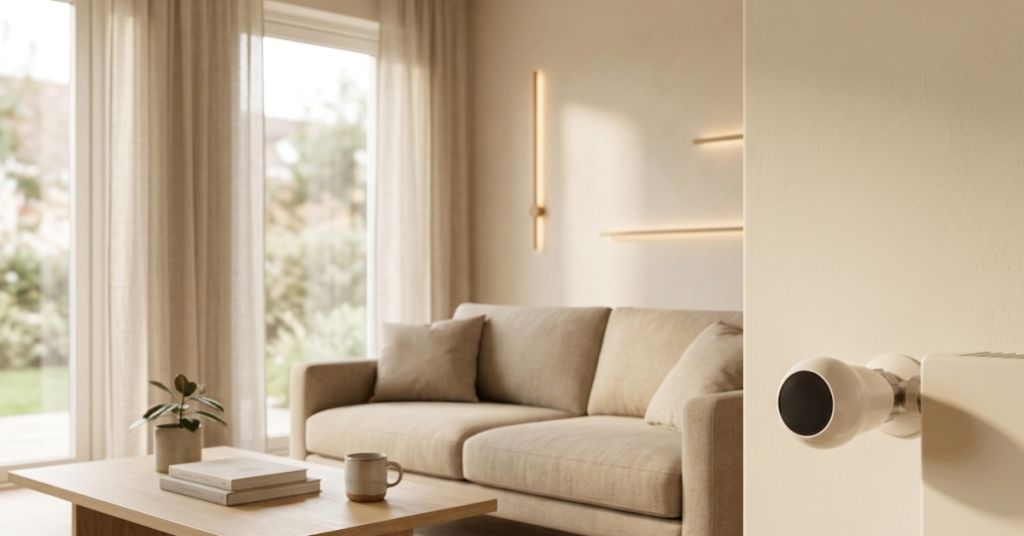
There was a time when “smart home” meant control. More apps, more dashboards, more settings. You could adjust everything, from temperature to lighting, often from anywhere in the world. It felt powerful, almost futuristic.
But something interesting happened along the way. The more control we had, the more attention these systems demanded. Instead of simplifying life, they often added another layer of decisions, notifications, and small daily frictions.
So the question becomes quite simple: what if the best technology is the one you barely notice?
From Smart to Invisible
The next phase of smart homes is not about adding more features, but about removing the need to think about them at all. Technology that disappears does not vanish, it blends into daily life so naturally that you stop interacting with it consciously. It learns from behaviour, adapts quietly, and steps in only when needed.
At its core, this kind of technology tends to share a few characteristics:
- it works in the background without demanding attention
- it adapts based on real behaviour rather than fixed rules
- it only becomes visible when something truly needs input
Heating is a good example. Many people still adjust thermostats several times a day, in the morning, in the evening, or when plans suddenly change. Even well designed schedules tend to break, simply because real life is not predictable. Invisible systems approach this differently by observing patterns and adapting without constant input.
Why Less Control Can Mean More Comfort
It may sound counterintuitive, but reducing manual input often improves the overall experience. Traditional smart systems assume that users always know what they want and are willing to manage settings regularly. In reality, comfort is fluid and depends on many factors, such as weather, activity, or even mood.
In everyday life, comfort is influenced by things like:
- how active you are during the day
- how the weather changes outside
- whether your routine follows a predictable pattern
A system designed to disappear shifts this responsibility. It learns over time and adjusts quietly, without asking for constant decisions. Control is still there when needed, but it is no longer something you have to think about every day. This is where many smart home solutions still struggle, they offer flexibility, but at the cost of attention.
Designing for Real Life, Not Perfect Scenarios
One of the biggest challenges in smart home design is the gap between ideal use and real use. In theory, users set up perfect schedules and never need to touch the system again. In reality, routines change, plans shift, and people forget.
Designing technology that disappears means accepting this from the start. Instead of asking how to give users more control, the better question is how the system behaves when users do nothing at all.
This shift leads to systems that are:
- more resilient when routines break
- less dependent on strict schedules
- better aligned with real human behaviour
At eCozy, this thinking is becoming increasingly important. The focus is not just on adding features, but on quietly supporting users, especially in moments when routines are not perfect.
The Role of Context and Behaviour
For technology to truly disappear, it needs context, not just data. It is not enough to know the temperature or the time of day. Systems need to understand patterns, such as when people are usually at home, how behaviour changes on weekends, or how the home responds to sudden weather shifts.
Good systems use this context to make subtle adjustments that feel intuitive, while poorly designed ones tend to overreact or behave unpredictably, which immediately brings attention back to the technology itself.
Trust as the Foundation
If users are expected to interact less with their systems, trust becomes essential. This trust is not built through complexity, but through consistency. A system that behaves reliably over time creates confidence and reduces the need for manual checks.
At the same time, transparency remains important. Even if the system is mostly invisible, users should always feel that they can understand what is happening and step in when needed. The balance is delicate: the system should be autonomous, but never feel out of control.
When Technology Gets Out of the Way
The most successful technologies tend to follow the same path. At first, they are visible and exciting. Over time, they fade into the background and become part of everyday life. Electricity is a simple example, we rarely think about it, yet it powers almost everything around us.
Smart homes are moving in a similar direction. The focus is shifting away from interfaces and towards outcomes, such as comfortable temperatures, reduced energy use, and fewer manual adjustments.
eCozy is part of this shift, especially in how heating behaviour is approached. The idea is simple: comfort should not require constant attention.
The Hidden Impact on Energy Efficiency
Another important aspect of disappearing technology is its impact on sustainability. When systems adapt automatically, they can optimise energy usage in ways that manual control rarely achieves. Small, continuous adjustments, based on real usage patterns, are often more effective than occasional large changes.
Over time, this leads to more stable consumption and less unnecessary energy use, making efficiency a natural outcome rather than a task.
Challenges on the Way Forward
Designing invisible technology is not easy. It requires a deep understanding of human behaviour, as well as the discipline to avoid overloading products with features. There is also a risk of over-automation, if systems become too independent, they may feel disconnected from user expectations.
The goal is not to replace human decision making, but to reduce unnecessary interactions while keeping meaningful control accessible.
A More Human Future for Smart Homes
In the end, the future of smart homes is not about being smarter, but about being more human. Technology should adapt to people, not the other way around. It should support daily life quietly, without demanding attention or creating friction.
Designing technology that disappears is a step in that direction. When done well, you do not notice the system, you simply feel comfortable at home.