
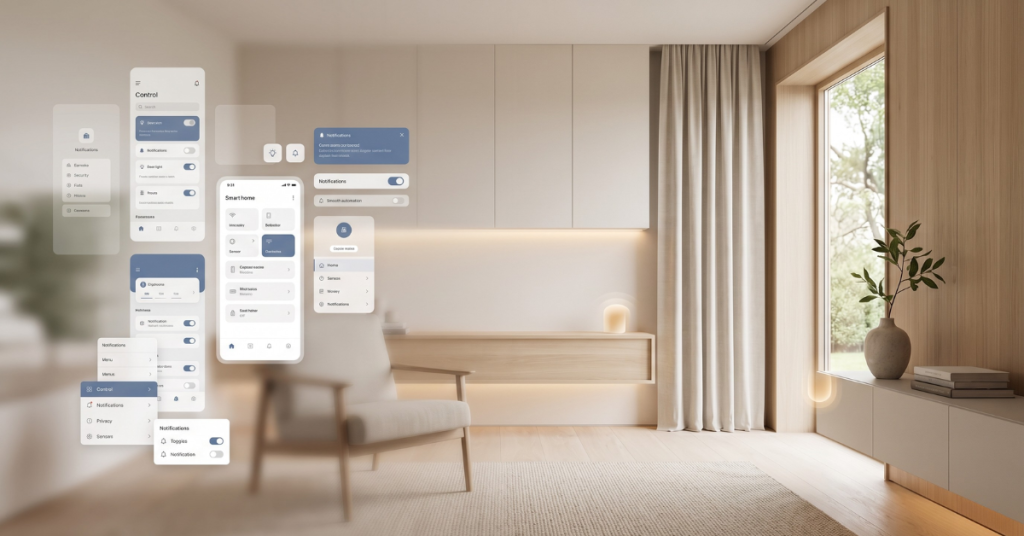
For years, the smart home industry focused on one main promise: control.
- Control your heating from your phone.
- Control your lights remotely.
- Control every device from a single dashboard.
At first, this felt revolutionary. The idea of managing your home from anywhere sounded futuristic and empowering. But over time, many users discovered something unexpected: more control does not always create a better experience. In many cases, it creates more decisions, more notifications, and more digital noise.
Today, the conversation around IoT is slowly changing. The best smart devices are no longer the ones demanding constant attention. Instead, they are the ones quietly supporting daily life in the background. This shift represents something bigger than a design trend. It is a new philosophy of user experience: moving from control to trust.
The Problem With “Always-On” Interaction
Many IoT products were designed with a simple assumption: users want visibility into everything. Apps became filled with graphs, toggles, settings, alerts, and automation rules. Some platforms almost turned homes into miniature control centres.
While power users enjoyed this level of customisation, the average user often experienced something different:
- Too many notifications
- Confusing interfaces
- Constant maintenance
- Automation that required manual adjustment
- A feeling that the “smart” system still depended heavily on them
Ironically, some smart products started creating the very friction they promised to remove. This happens because many IoT experiences were built around technological capability instead of human behaviour. Just because a user can adjust something every hour does not mean they want to.
In reality, people are looking for simplicity. They want technology that understands context, adapts naturally, and reduces mental load rather than increasing it.
Trust Is the New Premium Experience
The most successful technologies today often disappear into the background. Think about good lighting in a room. You rarely notice it when it works well. The same principle increasingly applies to IoT. Users do not want to manage devices all day. They want confidence that the system will behave correctly without constant supervision.
Trust in IoT comes from several things:
Reliability
A smart device should behave predictably. If users need to troubleshoot it every week, trust disappears quickly.
Transparency
Automation should feel understandable, not mysterious. Users should know why something happened without needing to study technical documentation.
Calm Interaction
Not every update deserves a notification. Good IoT design respects attention and avoids unnecessary interruptions.
Adaptation
The best systems learn patterns gradually and support routines naturally instead of forcing users to configure endless rules. This is where modern smart home experiences are evolving. Companies are starting to realise that the ultimate goal is not maximum interaction, but minimum required effort.
Designing for Human Behaviour
One of the biggest mistakes in IoT UX is assuming that users behave rationally and consistently.
In reality, human behaviour is emotional, contextual, and often unpredictable. People forget settings. They ignore notifications. They postpone updates. They abandon complicated onboarding processes.
Good user experience design accepts these realities instead of fighting them. For example, a heating system should not expect users to constantly optimise schedules manually. Most people simply want comfort without needing to think about temperature management every day.
This is one reason why adaptive systems are becoming more important. Instead of forcing users to manage every scenario, devices can quietly learn preferences and adjust automatically over time.
At eCozy, this idea strongly influences how smart home experiences are approached. The goal is not to make users spend more time inside an app. The goal is to help technology fade naturally into everyday life.
The Rise of Calm Technology
The idea of “calm technology” is becoming increasingly relevant in IoT. Calm technology does not compete aggressively for attention. Instead, it communicates information subtly and only when necessary. This philosophy matters because modern users are already overwhelmed by digital interactions:
- Smartphones
- Emails
- Social media
- Work platforms
- Messaging apps
- Smart watches
- Endless notifications
Adding another demanding interface into the home often creates fatigue instead of convenience.
A calmer IoT experience may include:
- Silent automation
- Fewer notifications
- Simpler interfaces
- More contextual intelligence
- Predictable system behaviour
- Reduced setup complexity
Interestingly, the less visible a smart system becomes, the more valuable it often feels. The best compliment for many IoT products is no longer “I use it every day.” It is: “I barely think about it anymore.”
Why Simplicity Is Harder Than Complexity
Creating a feature-heavy product is relatively easy. Creating a simple experience is much harder. Simplicity requires restraint. It means asking difficult questions:
- Does this feature actually improve daily life?
- Does this notification need to exist?
- Are we solving a real problem or showcasing technology?
- Can the system make this decision automatically?
- Is the interface helping or overwhelming?
Many IoT companies still measure success through the number of features added. But users rarely evaluate products that way. Most people remember:
- Whether the setup was frustrating
- Whether the device behaves consistently
- Whether the app feels stressful
- Whether the system saves time or creates extra work
The emotional experience matters as much as the technical capability.
Privacy and Trust Go Together
Trust in IoT is not only about usability. It is also deeply connected to privacy. As devices collect more behavioural data, users are becoming more conscious of how their information is handled. This creates a new expectation: smart systems should feel respectful, not invasive.
Companies that communicate clearly about data usage, prioritise security, and avoid manipulative engagement tactics are more likely to build long-term trust. The future of IoT UX will depend heavily on this balance:
- Smart enough to be useful
- Respectful enough to feel safe
Users increasingly value products that reduce anxiety rather than amplify it.
The Future of IoT UX
The next generation of smart home experiences will likely look very different from early IoT products. Instead of dashboards filled with controls, we may see systems that:
- Require minimal interaction
- Adapt automatically
- Communicate only when necessary
- Integrate naturally into routines
- Prioritise emotional comfort alongside functionality
The industry is gradually learning an important lesson: intelligence is not about how much a system can do. It is about how naturally it fits into human life. The future of IoT is probably not more screens, more settings, or more notifications. It is more trust.
And perhaps the most advanced technology is the kind that quietly helps people without constantly reminding them it exists.
As the smart home market matures, companies that focus on human-centred experiences rather than feature overload will likely stand out. At eCozy, this shift towards calmer, more intuitive living spaces reflects a broader movement across the industry: technology should support life, not dominate it.