
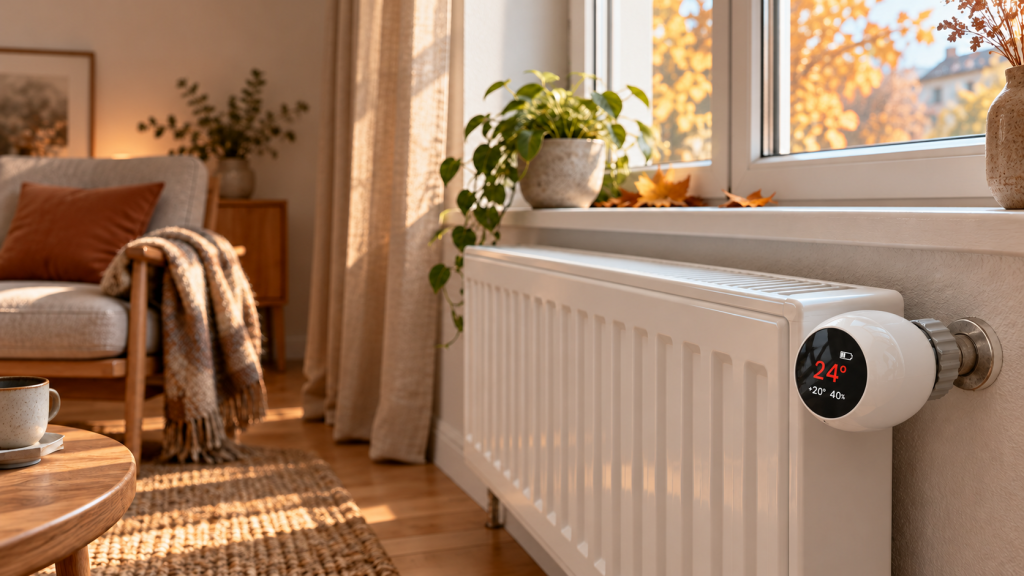
The first cold morning has a way of exposing everything you meant to fix last winter. The bathroom is chilly, the spare room is warmer than it needs to be, and somebody has turned the living room thermostat up again.
Smart heating in 2026 should make those situations easier to manage. It should provide dependable room control, schedules that fit real life, clear information about energy use and straightforward integration with the rest of the home. Basic heating functions should also remain usable when an online service is unavailable.
That is a useful standard for the new heating season. Whether you are upgrading a flat or developing a connected heating product, the question is practical: does the technology help people stay comfortable with less unnecessary heating and less daily effort?
Smart heating in 2026 should start with the room
A home rarely needs the same temperature everywhere, all day. A bedroom, home office and bathroom have different routines. Good heating control should make those differences easy to express.
Consider a household where one person works from home on Tuesdays and Thursdays. A useful setup might warm the office on those mornings, keep a more modest setting on other weekdays and allow a quick change when plans shift. Nobody should need to rebuild the whole schedule for one unexpected day at home.
When comparing systems, look at ordinary tasks. Can you change one room without affecting the others? Can a temporary adjustment expire automatically? Can another household member use the heating without borrowing your phone?
Those details deserve as much attention as the feature list.
Know what a radiator thermostat actually controls
A smart radiator thermostat adjusts the valve on an individual water-filled radiator. It does not automatically become the controller for the boiler, heat pump or entire building.
Check compatibility with both the radiator valve and the wider heating arrangement. The mechanical fit, any required adapter and the available connection to the heat source are separate questions. A successful app connection does not answer all three.
For rented homes, establish what can be changed and keep the original thermostat heads where replacement is permitted.
Automation should explain its decisions
Useful automation follows a routine but leaves room for exceptions. A holiday setting should be easy to find. A guest should be able to make a room comfortable. An unexpected late return should not require navigating several menus.
Learning functions deserve the same scrutiny. Machine learning means software identifying patterns in data and using them to adjust its behaviour. For heating, ask what the system learns, what information it uses and how you can correct it.
An unexplained change in temperature is frustrating, even when an algorithm intended to help. A clear message such as “temporary setting until 18:00” is often more valuable than a complicated dashboard.
One example of this technical direction is eCozy 2.0. Nordic Semiconductor describes a radiator thermostat platform combining Matter-over-Thread connectivity with on-device machine learning and cloud algorithms. These are distinct capabilities: communication, local processing and online processing should each have a clearly explained role.
Matter and Thread should make compatibility clearer
Matter is a smart home communication standard developed by the Connectivity Standards Alliance. It provides a common application language for compatible devices and platforms. Matter can use Thread, Wi-Fi or Ethernet for network communication.
Thread is a low-power wireless mesh networking technology. A Thread Border Router connects that network to other IP networks in the home, such as Wi-Fi or Ethernet.
For buyers, the important point is that Matter and Thread do different jobs. Neither name alone describes everything a heating product can do.
Check the functions you actually want to use
Before buying, ask for confirmation of the intended setup:
- Which controller and, where needed, Thread Border Router are required?
- Can your chosen platform adjust the target temperature and show the current reading?
- Where are schedules stored and managed?
- Which functions require the manufacturer’s app or a subscription?
A useful compatibility statement should name the supported functions, platform and relevant software requirements. For installers and IoT teams, documenting that combination is part of delivering a usable product.
Reliability includes what happens without the internet
Remote access is convenient when you are travelling. At home, the more revealing test is what happens when broadband stops working.
Matter provides local connectivity, while remote control requires an internet-connected controller. However, the availability of schedules, learning features and app functions during an outage depends on the product’s implementation.
Ask the supplier to distinguish between a broadband outage, an unavailable cloud service and a powered-off home controller. These are different failures. A product might handle one well while depending on another component for its usual behaviour.
For a heating system, a sensible demonstration includes changing the temperature at the device, checking what happens to stored settings and confirming recovery after connectivity returns.
Energy savings need a credible baseline
Automation can reduce avoidable heating, particularly where temperatures were previously adjusted infrequently. But there is no universal savings figure for every home. Building condition, household behaviour and the chosen system all influence the outcome, as Germany’s Verbraucherzentrale explains.
Start by identifying the problem you want to solve. Perhaps the guest room stays at a comfortable occupied setting all week, despite being used only occasionally. Perhaps the heating schedule still reflects working hours from two years ago.
Make one clear change, then review comfort and consumption over a meaningful period. A lower bill alone does not prove lower energy use, because tariffs can change. A colder month can also complicate comparisons.
Separate measurements from estimates
When an app displays energy information, ask how it was produced. Is it a meter reading, an estimate based on heating activity or a relative indicator?
All can support decisions if labelled clearly. They should not be treated as interchangeable. For example, a chart showing how long a valve was open does not, by itself, establish how many kilowatt-hours the home consumed.
Clear units, dates and calculation methods should be part of good product design.
Room control belongs within the wider heating system
Smart thermostats are one part of heating efficiency. The Verbraucherzentrale also highlights heating-system settings, pipe insulation, pumps and hydraulic balancing, which helps distribute heating water appropriately through the system.
If one room never reaches its target temperature, investigate rather than repeatedly raising the target. Give an installer a clear description: which room, at what times and under which settings?
For a heat pump installation, ask how room control should interact with the system’s intended operating strategy. Do not assume a schedule copied from another property will suit it.
The same principle applies to underfloor heating and mixed systems: choose controls around the actual installation.
Prepare the setup before the coldest weeks
Use the start of the season for a practical check. Confirm that each room responds as expected, review the weekly schedule and check any battery or connection warnings. Install available updates according to the manufacturer’s instructions.
Also review the questions that are easy to postpone: how long are security updates promised, which data leaves the home and how can access be removed when someone moves out?
For companies developing heating and HVAC products, these are useful acceptance criteria. Heating, ventilation and air conditioning systems need a handover that explains operation, recovery and support. A successful pairing screen is only the beginning.
Frequently asked questions
Do smart thermostats guarantee lower heating bills?
No. Assess the opportunity against your current habits and installation. A household that already manages temperatures carefully should not assume the same improvement as one with frequent unnecessary heating.
Do I need to replace my heating system?
Not necessarily. Start by checking whether compatible radiator thermostat heads can be fitted to the existing installation. Replacing radiator controls and replacing the heat source are different projects.
What should I test before expanding to every room?
Try everyday temperature changes, schedule overrides, household access and recovery after a connection interruption. Choose a room that reflects how you actually use the home.
A practical standard for the new heating season
Smart heating in 2026 should earn its place through comfortable rooms, understandable controls and dependable operation. Look for compatibility you can verify, automation you can correct and energy information you can interpret. The best starting point is a specific heating problem in your own home, followed by a setup that solves it consistently.